Condenser Microphones
Condenser means capacitor, an electronic component which stores energy in the form of an electrostatic field. The term condenser is actually obsolete but has stuck as the name for this type of microphone, which uses a capacitor to convert acoustical energy into electrical energy.Condenser microphones require power from a battery or external source. The resulting audio signal is stronger signal than that from a dynamic. Condensers also tend to be more sensitive and responsive than dynamics, making them well-suited to capturing subtle nuances in a sound. They are not ideal for high-volume work, as their sensitivity makes them prone to distort.
How Condenser Microphones Work
A capacitor has two plates with a voltage between them. In the condenser mic, one of these plates is made of very light material and acts as the diaphragm. The diaphragm vibrates when struck by sound waves, changing the distance between the two plates and therefore changing the capacitance. Specifically, when the plates are closer together, capacitance increases and a charge current occurs. When the plates are further apart, capacitance decreases and a discharge current occurs.A voltage is required across the capacitor for this to work. This voltage is supplied either by a battery in the mic or by external phantom power.
And a small diagram for good measure:
Cross-Section of a Typical Condenser Microphone

Next up:
Dynamic Microphones
Dynamic microphones are versatile and ideal for general-purpose use. They use a simple design with few moving parts. They are relatively sturdy and resilient to rough handling. They are also better suited to handling high volume levels, such as from certain musical instruments or amplifiers. They have no internal amplifier and do not require batteries or external power.How Dynamic Microphones Work
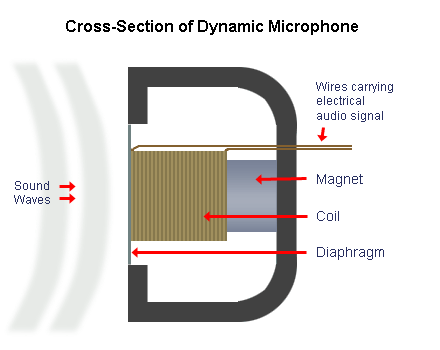
As you may recall from your school science, when a magnet is moved near a coil of wire an electrical current is generated in the wire. Using this electromagnet principle, the dynamic microphone uses a wire coil and magnet to create the audio signal.The diaphragm is attached to the coil. When the diaphragm vibrates in response to incoming sound waves, the coil moves backwards and forwards past the magnet. This creates a current in the coil which is channeled from the microphone along wires. A common configuration is shown below.
One more diagram:

No comments:
Post a Comment